
Kavi Dalpatram Chowk: A Literary Stop on Ahmedabad’s Heritage Walk
Understand what survives and what was reconstructed
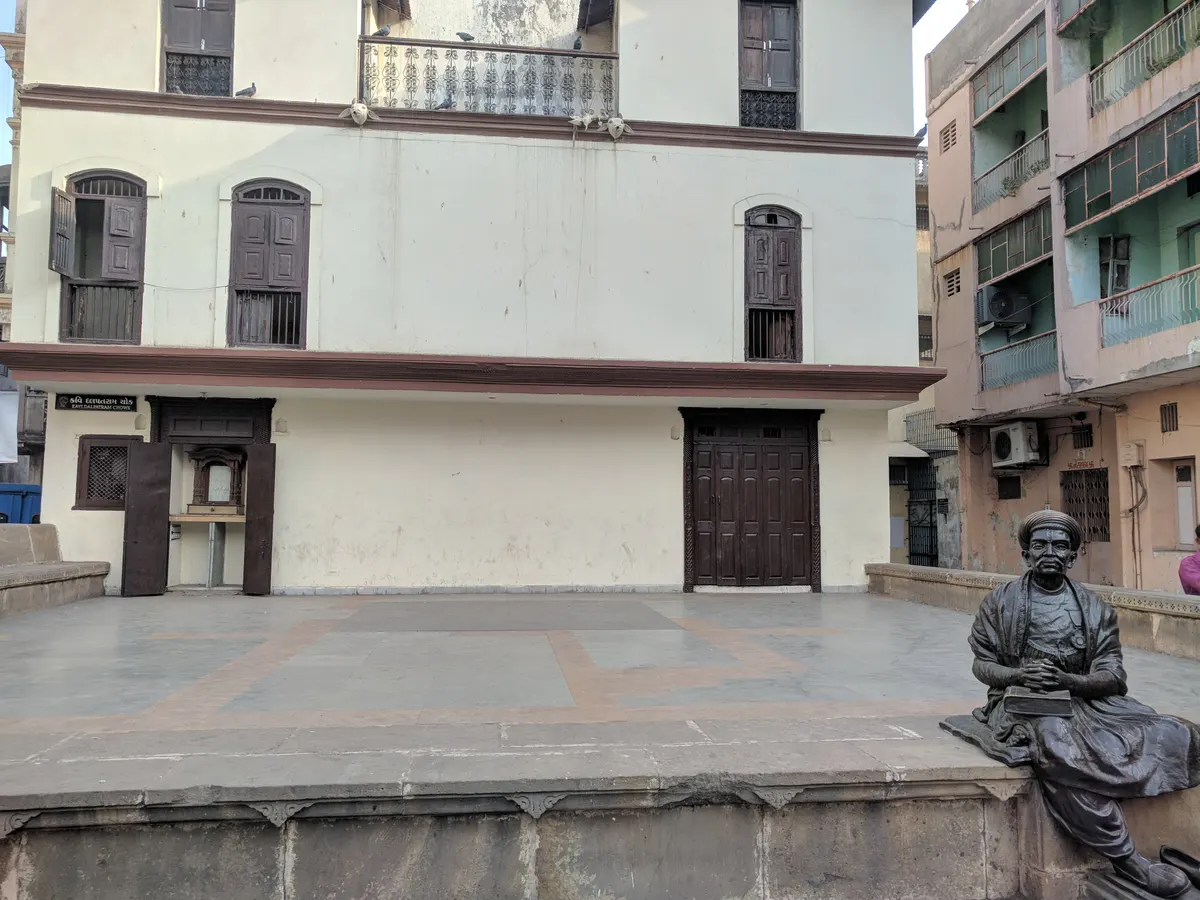
AMC Heritage City explains that the house where Gujarati poet Dalpatram lived was destroyed around 2001. The open square now contains a memorial statue commissioned in 2001, while the building behind it is a replica of the original house. That distinction is essential. The site is meaningful, but a responsible caption should not present the replica as untouched nineteenth-century fabric. Explain the memorial, square and reconstructed context as three related layers.
Read the chowk as public space
Begin from the edge rather than walking straight to the statue. Observe how the square opens within the tighter lanes and how surrounding façades frame it. The change in scale is part of the experience of Ahmedabad’s pol environment. Photograph one view that includes the paving, statue and house context, then make a second frame from a different edge. These views show why a chowk is more than a background: it is a pause in the circulation of the neighbourhood.
Use the statue as an invitation to research
A memorial sculpture identifies the person a community chose to remember, but it cannot carry a complete literary biography. Record the name accurately and use a library, archive or authoritative publication for deeper claims about Dalpatram’s works and historical role. Avoid inventing a quotation for a dramatic caption. If you include verse, verify the wording, edition and translation, and respect copyright where it applies. A short reel can simply direct viewers toward further reading.
Look at the replica without confusing it for evidence
The house behind the square offers a visual suggestion of the earlier residence, according to AMC’s record. Study its openings, proportions and relation to the square, but label it as a replica. Do not use decorative features in the current structure to make unverified claims about the demolished original. This is a useful lesson in heritage interpretation: reconstruction can help people imagine a lost setting while still requiring transparent labels about what is new.
Connect the stop to the official walking route
AMC lists the chowk as a stop on the Heritage Walk beginning at Swaminarayan Mandir Kalupur. Seeing it in sequence helps visitors move from a major religious complex into smaller public and residential spaces. Check current walk schedules and booking details directly before relying on them. If visiting independently, remain aware that this is an inhabited area: keep doorways clear, avoid loud narration and do not photograph residents through windows or into homes.
Create a compact literary-place story
Use four beats: an approach through the lane, the full square, the statue and the replica-house relationship. Add one verified line explaining the demolition and 2001 memorial commission. Then invite the audience to identify a Dalpatram work through an authoritative source rather than presenting unsourced trivia. Natural ambient sound and a steady walking shot can communicate place without staging people or pretending that the camera has recreated the poet’s lifetime.
Why this small stop matters
Kavi Dalpatram Chowk demonstrates that urban heritage can survive through memory, naming, reconstruction and continued public use even when original fabric is lost. That is more complex—and more useful—than calling the site old or hidden. Date your footage, credit the municipal source and acknowledge the replica plainly. A careful Beyond Soch story can make a modest square legible without exaggerating it, while encouraging readers to connect Ahmedabad’s built heritage with its literary history.